
In October 2007 Raja Sen visited Louisiana governor Bobby Jindal's village in Punjab to find out how its residents, and relatives, feel about their oddest export. His report was published in India Abroad, a weekly newspaper published in the US and owned by Rediff.com.

'For a long time Pakistan dreamt that India would break up and that it would be the predominant power in the region,' says Colonel Anil A Athale (retd).
Natwar Singh's book is un-illuminating, largely self-justificatory, often contradictory, and at times tendentious. He is too preoccupied with depicting himself as a victim of the Congress party's machinations, says Praful Bidwai.

25 winters have passed. More will pass, but the fight will go on. In spite of successive governments' unwillingness to sincerely reverse ethnic cleansing of Kashmiri Hindus and provide them justice, they will steadfastly work towards securing their rights and homeland, says Lalit Koul.

'Why does it exist in the film industry?' 'It is because we are culturally nepotistic.' 'The son always grows up to carry on the work of the father; that's where we come from.' 'So if you have to tackle nepotism in the film industry, you have to tackle it in our culture.'

'Checkmating India by its nukes, Pakistan can pursue terrorism against India in the Kashmir Valley and also resume launching Mumbai 2008 style attacks.' 'The military oligarchy in Pakistan has a totally different view of what is desirable and possible in the subcontinent.'

'There are so many dimensions to history that we need to attend to: We need more space for local and regional histories; we need to delve into the histories of particular communities; we need to emphasise gender history and environmental history.' 'We need to think about India's history beyond India's current borders.'
'While India's 'secularism' is a matter of cultural values rooted in Hinduism, the Western concept became one of rights rooted in legal rights. India would be secular with or without Article 25 of the Constitution,' says T V R Shenoy.
'We are no longer striving for a strategic partnership. We have arrived at one.'

'While military acts such as the Uri surgical strikes are one option, cultural, economic and diplomatic isolation should also be part of the arsenal,' argues Sankrant Sanu.

How to deal with a country that has made export of terror a reason to make the world notice and fund it? Rediff.com contributor Sanjeev Nayyar offers a few suggestions

The outcome of the Bangkok NSA-level talks underscores that Pakistan has got exactly what it wanted -- talks at different levels, talks on Kashmir, talks on mutual concerns regarding terrorism, talks on ceasefire on the border. What if any has been India's gains remains unexplained, says Ambassador M K Bhadrakumar.

The facts remain cloaked in mystery, but the legend goes that Talpade had created a flying machine powered by mercury and solar energy, and based on ideas outlined in Vedic texts.

Kainchi, near Nainital, attracts devotees from near and far, 42 years after the death of its spiritual leader, Neem Karoli Baba.

Rajdeep Sardesai's 2014: The Election That Changed India, will make him a ton of money, says Shreekant Sambrani, but admits he is more interested in knowing whether the book lives up to its title.
Prime Minister Narendra Modi's real test will be whether he can bring a longer-term vision to India's foreign policy planning, says Ravi Agrawal.

'The book was NOT banned. There were NO book burnings. There were NO riots. The author was NOT sent death-threats. On the contrary, the plaintiffs pursued due process. The case is a textbook example of how to proceed with civilised, democratic dissent,' says Rajeev Srinivasan.
'Where does one draw the line? At what point does your right to free speech cross the limit of civilised discourse and provoke me to take offence?' 'And if you have the right to offend, what about someone else's right to be offended?' asks Hasan Suroor.
The State is trying to curb the students movements, therefore, there are suspicions against some of the Subramanian report on education's recommendations, says Mohammad Sajjad.

The government must justify why we need to buy foreign reactors when we have developed up to 700 MWe unit-size pressurised heavy water reactors, a design which can be easily extended to 900 to 1000 MWe unit size. Why can't the 'Make in India' philosophy apply to indigenous nuclear reactors, more than 18 of which have been designed, built, and being operated by Indian engineers, asks Dr A Gopalakrishnan.

Bestselling author Dan Brown spoke at the Penguin Annual Lecture in Mumbai on November 12. Snapshots from the evening

'This is a new phenomenon,' says Shekhar Gupta. 'Does it point to the rise of egomania, and could it also be a reason our politics is broken and Parliament non-functional? Where our biggest leaders talk not to, but at each other.'

'The creation of Pakistan was integral to Britain's grand strategy.' 'If they were to ever leave India, Britain's military planners had made it clear that they needed to retain a foothold in the NWFP and Baluchistan because that would provide the means to retain control of Iran, Iraq, Kuwait, the UAE, Bahrain and Qatar.'

With Beijing having had a profound rethink on India's admission as a full member of the Shanghai Cooperation Organisation, the tectonic plates of the geopolitics of a massive swathe of the planet stretching from the Asia-Pacific to West Asia are dramatically shifting. That grating noise in the Central Asian steppes will be heard far and wide -- as far as North America, says Ambassador M K Bhadrakumar.

His sartorial taste is not something he acquired suddenly as the chief minister of the prime minister. His "god-given" dress sense is like his politics: inventive, imaginative if slightly unconventional, often loud. It goes well with his oratory, robust persona and penchant for coining terms, says Mahendra Ved.

Research and teaching have remained Professor Chintamani Nagesa Ramachandra Rao's first priority and first love, and that is what sets him apart, says Dinesh C Sharma
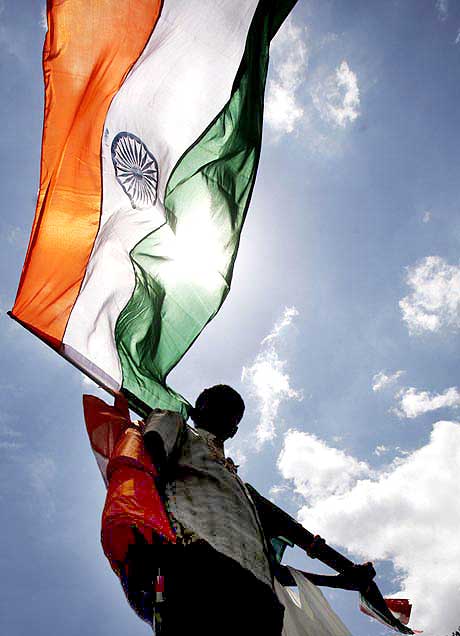
How has the Indian State, in principle and practice, given shape to the essential ingredients of the secular principle and composite culture?

The RSS realises that with a majority BJP government at the Centre and in several states, now was the best time to undermine and perhaps outdo the Congress-Left 'stranglehold' over campuses and young minds.

'Competition makes us better. I lose a little bit of sleep because I have competition.'

'In Hindu society, marriage is not between a man and a woman, but between their castes; politicians do not ask for human votes, but for caste votes....' 'Have you heard of such nonsense anywhere else in the world? And we claim we are civilised!' 'One or two or a few people becoming President, Prime Minister, Chief Minister, Speaker etc from the downtrodden do not mean that the untouchables are uplifted and caste-based slavery is over.'

'If you go up to an average American or British citizen, and tell them you are a Muslim, they look at you suspiciously. It's not a good feeling,' Saif Ali Khan tells Sonil Dedhia.
'Under Narendra Modi's leadership, we will be able to regain our rightful place in the community of nations,' veteran diplomat Hardeep Singh Puri, who joined the BJP on January 2, tells Rediff.com's Sheela Bhatt.

Anti-conversion laws are needed since thrusting the idea of a competitive battlefield of religion onto India's pluralistic traditions can only lead to greater communal conflict, says Sankrant Sanu

ACN Nambiar's life was extraordinary and intricately linked to momentous turns in history. Having lived in Europe for five decades, he was witness to and entangled with what we today -- with the benefit of hindsight -- call recent history.

'Pakistan is full of 'religious entrepreneurs' like Hafeez Saeed who poison the minds of the young so that they can be motivated to become terrorists. They work in concert with the rulers of Pakistan. It is a private-public partnership.'
Shekhar Gupta's anthology is a valuable addition to our understanding of the seeming muddle that is India... The experience of reading his columns is more like a chat with a friend in the afterglow of an enjoyable drink, but never frivolous, says Shreekant Sambrani.

Ashraf Palarakunnummal has one mission in life -- to ensure the dignity of the dead. This he does by seeing to it that expats who die in the Gulf are transported back to their home countries without too many hassles for the bereaved families. Shobha Warrier/Rediff.com talks to the Good Samaritan who was honoured with the Pravasi Bharatiya Samman recently.

'After Rajan is back in India, our resident dons are almost down. I won't say that they are out. So, now the obvious question is about Dawood, and the present government, I think, is more than willing to address that issue.' 'I think the political system made this kind of people; the corporate world made this kind of people. I have mentioned in my book that even the banks were using these outlaws to get their money back.'

'The Indian government has accepted and is a party to international agreements, standards and conventions on religious freedom.' 'We did not force it on them. We are not trying to impose something on them that they haven't already agreed to...' 'India has never allowed us to visit, which is very disappointing for such a wonderful country with such a rich democratic tradition. They seem to be afraid to let us in.'
